

Summer heat in New Jersey puts real stress on home appliances. Your refrigerator works harder during humid July and August weather. When the fridge section stops cooling and the freezer stays frozen, something specific has gone wrong inside the unit. This is one of the more common calls we get during the summer months.
If your food is already warm, do not wait. Call Immediate Appliance at 732-431-2004 for same-day refrigerator repair service. We serve Monmouth, Ocean, Middlesex, Mercer, and Somerset counties throughout New Jersey.
Why the Freezer Works but the Fridge Does Not
This is a question that trips a lot of homeowners up. The short answer is that both sections share the same cooling system. Cold air is generated in the freezer and pushed into the refrigerator section by a fan. So if the freezer is fine, the compressor is likely working. The problem is usually somewhere between the freezer and the fridge section. That narrows things down considerably.
Below are the most common causes technicians find when this specific problem comes up during a service call.
Common Reasons Your Refrigerator Stops Cooling in Summer
The Evaporator Fan Has Failed
The evaporator fan sits inside the freezer compartment. Its job is to push cold air through the vents and into the refrigerator section. If the fan motor burns out or the blades get blocked, that airflow stops. The freezer temperature stays normal because it is right next to the evaporator coils. Meanwhile, the fridge section climbs toward room temperature. A failed evaporator fan is one of the most common causes of this exact problem.
You can do a quick test. Open the freezer and listen for the fan running. If you hear nothing, that is a strong sign the fan motor needs to be replaced.
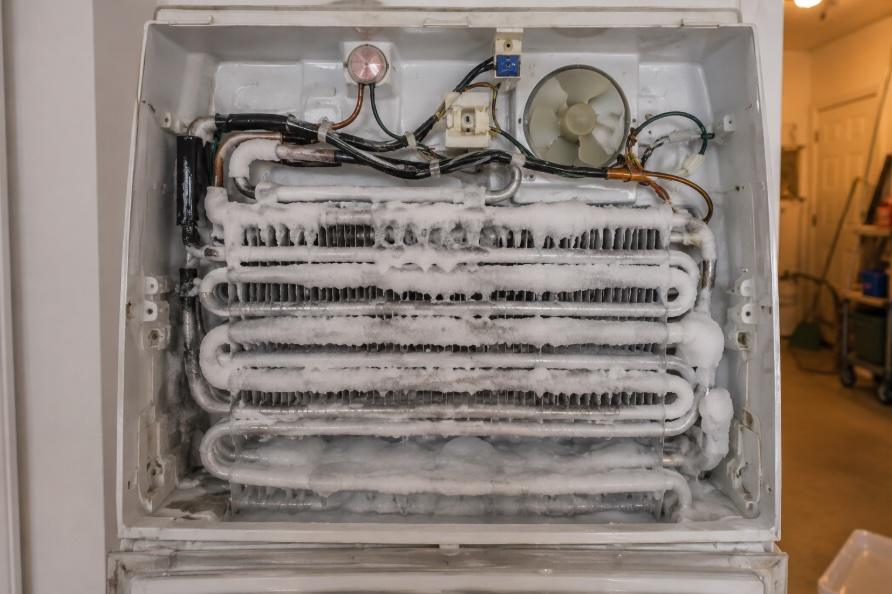
The Evaporator Coils Are Frozen Over
This one surprises people. Too much frost buildup on the evaporator coils can actually block airflow completely. It sounds like the opposite of a cooling problem, but it is not.
When the defrost system fails, ice accumulates on the coils over time. Eventually the airflow is restricted to the point that nothing reaches the fridge section. In summer, a failing defrost heater or defrost thermostat gets pushed harder and tends to give out faster.
A technician can defrost the coils manually and test the defrost system components to find out what failed.
Dirty or Clogged Condenser Coils
The condenser coils are usually located along the back or bottom of the refrigerator. They release heat as part of the cooling process. In summer, ambient kitchen temperatures are already higher. If those coils are coated in dust and pet hair, the unit has to work that much harder to shed heat. Over time, this puts serious strain on the compressor and reduces cooling efficiency in the fridge section first.
Cleaning the condenser coils is something homeowners can do themselves with a coil brush. However, if the problem persists after cleaning, there may be additional damage from prolonged strain on the system.
A Faulty Damper Control
Between the freezer and refrigerator sections sits a small but important part called the damper or air diffuser. It is essentially a flap that opens and closes to regulate how much cold air flows into the fridge section. If the damper gets stuck in the closed position, cold air cannot get through. The freezer keeps working perfectly and the fridge goes warm. This is a repair that requires a technician, as the part needs to be accessed and replaced.
An Overstuffed Refrigerator or Blocked Vents
This one is a DIY fix. Blocking the vents inside the refrigerator with food containers prevents cold air from circulating. Similarly, overloading the unit reduces airflow throughout. The general guideline is to keep the fridge about three-quarters full. Enough to maintain temperature efficiently, but not so packed that air cannot move. Check that nothing is pushed directly against the interior vents before calling for service.
Thermostat Issues
A faulty thermostat can cause the unit to stop cycling properly. If the thermostat is not reading the temperature correctly, it may signal the system to stop cooling before the fridge section reaches the right temperature. In summer, when the unit is working harder, a borderline thermostat that functioned fine in winter may start to fail under the added load.
When to Call a Technician
Some of these issues are simple to check yourself. Others require disassembly and diagnostic tools. As a rule, if a quick check of the vents and coils does not resolve the problem within a day, it is time to call a professional. Food safety is a real concern. Bacteria grow rapidly in a refrigerator that stays above 40 degrees Fahrenheit for more than two hours.
For urgent situations, our emergency refrigerator repair service is available when you cannot afford to wait.
How Summer Heat Makes This Problem Worse
New Jersey summers run hot and humid. Toms River, Brick, and Freehold can see stretches of 90-plus-degree days from June through August. During those stretches, refrigerators run almost continuously.
A unit that is already showing early signs of a failing fan or clogged coils can go from sluggish to broken very quickly when the ambient temperature climbs. Preventive maintenance in late spring can catch these issues before they turn into a full-blown repair call in the middle of a heat wave.
Should You Repair or Replace?
If your refrigerator is under 10 years old, repair is almost always the right call. Most component failures on a modern fridge cost far less than a replacement unit. If the unit is over 15 years old and this is not the first issue, the math starts to shift. Our technicians can give you an honest assessment on whether a repair makes financial sense for your specific unit. There is no pressure either way. See our related post on repair vs. replacement for more guidance.